Sir Terry Farrell had a huge impact on Newcastle’s skyline and urban identity over a period of nearly three decades. With his passing in September of 2025 and the Farrell Centre carrying on his work, the city is now facing a key question: can it keep up with the level of design ambition he championed, or will it settle for filling in the gaps left behind?
Newcastle’s Future After Farrell: The City’s Big Question
Stroll along the Quayside in 2026, and it’s immediately clear that one architect’s influence still has a major presence. You’ve got the graduated terraces sloping down to the Tyne, the mixed-use blocks framing the views of the bridges, and the Centre for Life shining beyond Central Station. Newcastle has a rich architectural heritage that goes way back to Georgian times, as well as more modern urban regeneration – and for a long time much of the city’s most innovative city-making bore the name of a single man.
Sir Terry wasn’t just designing buildings, he was also an architectural champion: a guy whose reputation, relationships and sheer force of will helped shape planning frameworks, public debate and the city’s very physical form. From the late 80s until the early 2000s, he played that role with remarkable consistency in Newcastle.
This article explores what happens when someone of that calibre is no longer there. Are the city’s architects and planners today producing a city worthy of its past glories, or has development fallen back to a piecemeal, plot-by-plot approach that views heritage as a backdrop rather than a foundation to build on? The themes we examine here – architectural identity, the challenges of star-driven urban development, the role of planning policy, and the impact of institutions like the Farrell Centre – are all written from the perspective of a historian of architecture in the North East, drawing on specific projects and planning decisions between roughly 1987 and 2025.
Understanding Farrell in Context: From Sale to the Tyne
Terry Farrell was born in 1938 in Sale, in the county of Cheshire. He came north to Newcastle to study at Newcastle University’s School of Architecture (which was then part of Durham University) where he graduated in 1965. He later went on to do a Masters in Urban Planning at the University of Pennsylvania – an experience that deepened his understanding of how cities work at a strategic level.
His early days in London saw him partnering with Nicholas Grimshaw from 1965, producing modernist work that really put Newcastle on the map. When that partnership came to an end, Farrell went on to found his own practice, Terry Farrell & Partners, which eventually evolved into the global firm Farrells, with offices in London, Hong Kong and Shenzhen. He was knighted in 2001 for services to architecture, and in 2016 was made an honorary freeman of Newcastle – a measure of the city’s respect for a British architect who had done more than most to reshape its identity.
Looking back, it’s striking how Farrell moved from his early high-tech modernism towards the more playful, post-modern style of the 1980s and 1990s. Emblematic of this is the TV-am headquarters in London (1983), with its decorative eggcup finials, and the MI6 building at Vauxhall (completed 1994), which are great examples of his contextual and occasionally radical approach to architectural styles. These weren’t background buildings – they demanded attention and sparked debate.
His wider urbanism work – his advisory roles on UK planning, his involvement in national reviews of the built environment – meant that by the time he turned his attention seriously to Newcastle, he brought with him not just design flair but also a framework for thinking about cities as interconnected systems. He passed away in September 2025, aged 87. The work he left behind along the Tyne is no longer a collaborative effort in progress – it’s now his legacy.
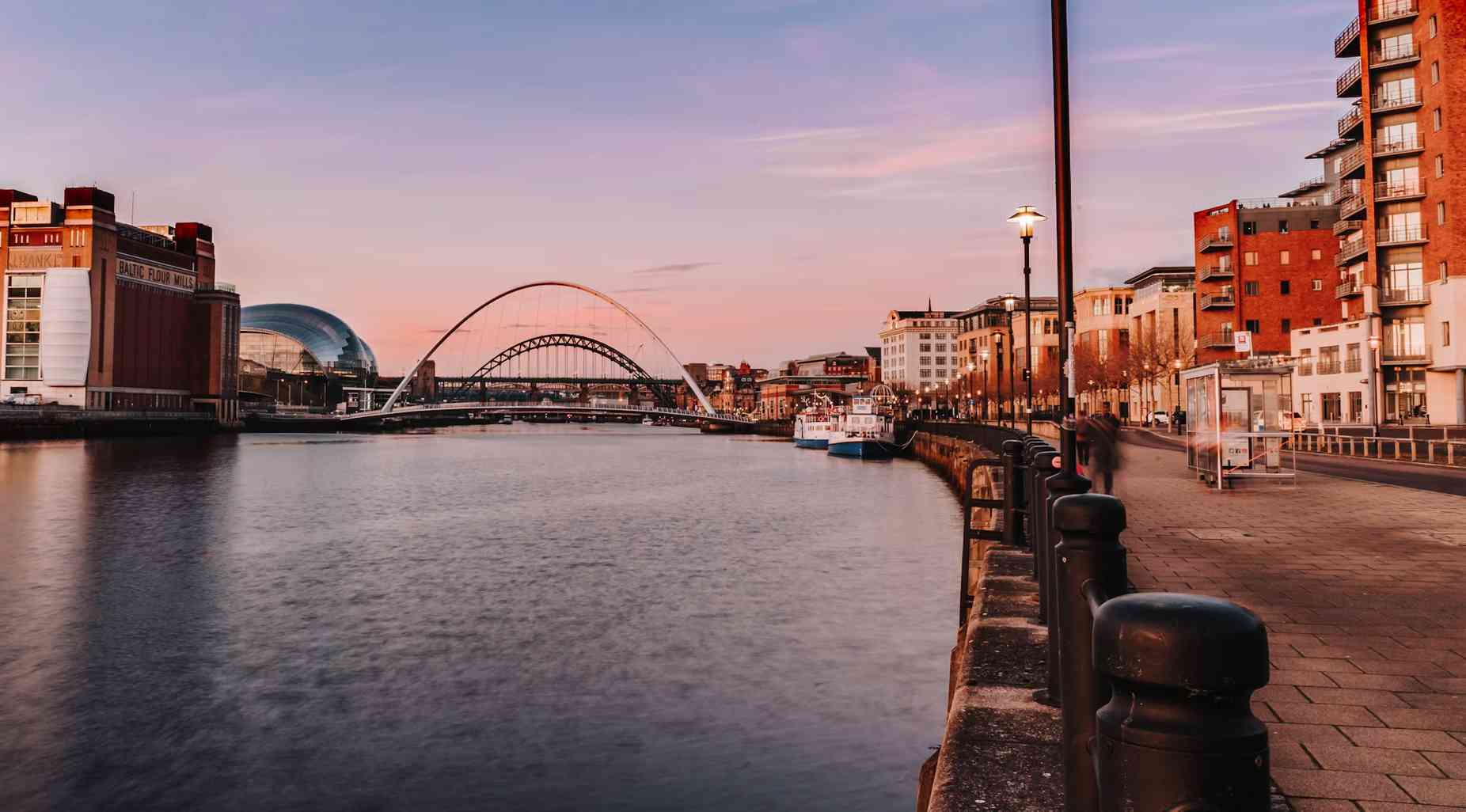 Remaking the Quayside: Farrell’s Tyne-side Masterplan
In the early 80s, the Quaysides of Newcastle and Gateshead were pretty run down – derelict wharves, abandoned warehouses and fragmented planning frameworks were all left over from post-war redevelopment, and the riverfront felt disconnected from the rest of the city. The Tyne, once the economic engine of the North East, had become a place where people moved through rather than a destination in its own right.
The establishment of the Tyne & Wear Development Corporation in 1987 created a window of opportunity, but initial plans for a “festival shopping” district never came to fruition. It was only in 1991 that Terry Farrell & Partners’ masterplan for East Quayside was adopted. Developer AMEC (later Muse) was appointed in 1992, and building took place in phases, with the final result being largely complete by 1998.
The design was deliberately chosen to:
- Create a stepped public realm that could tackle the dramatic level change between the city and the river
- Use mixed-use blocks along the Tyne, with active ground floors rather than featureless office podiums
- Frame views and vistas that celebrate the bridges and waterfront
- Give priority to pedestrians and create public squares that tie the city’s fabric to the water’s edge
These features were a harbinger of what would a little later get labelled “place-making” – the notion that good urban design treats streets, squares and vistas with the same care that it does individual buildings. The Quayside created a template that later Newcastle architects would either follow or more likely deliberately take issue with. It’s going to be marked in 2026, the 40th anniversary of the master plan, by an exhibition at the Farrell Centre, a testament to just how enduring the project’s influence proved to be.
The Centre for Life and the Science City Vision
The Centre for Life is another standout Farrell project, opened in 2000 on former railway land to the south of Central Station. It was part of a bigger plan called the “Science City” initiative which aimed to merge research, education, public engagement and urban regeneration into one overall vision.
Farrell’s approach to the architecture was characteristic. Rather than some grand, single, eye-catching building, he designed a cluster of buildings around a civic square – Times Square – where the Life Science Centre, laboratories, offices and public realm could all come together. And the goal was quite deliberate: he wanted families, researchers and school groups to be drawn into the same urban space, blurring the boundaries between scientific work and everyday city life.
The project showed an impressive sensitivity to the existing built environment. It made good use of the surrounding railway infrastructure and historic fabric without trying to clear the slate and start from scratch. And in doing so, it also shifted the urban geography of Newcastle, creating a new hub of activity on land that had been on the fringes for decades.
What really made the Centre for Life a standout in Farrell’s portfolio was its social ambitions. It showed that architecture and planning could be used in tandem with economic and social policy to drive real change. The development helped to kick-start investment in adjacent areas, demonstrating that cultural and scientific programs – not just commercial office space – could be the anchor that drives urban regeneration. It remains one of the largest science centres in the country.
Beyond Icons: Farrell’s Influence on Newcastle’s Planning Culture
Farrell’s impact on Newcastle went way beyond his own buildings though. From the 1990s onwards, he took on a growing role as a national advisor, culminating in the 2014 “Farrell Review” of architecture and the built environment in the UK. That review of architecture called for “urban rooms”, citizen engagement, conservation, mixed-use development, density and the integration of transport with development.
In Newcastle, these ideas started to take on a more practical form. His practice contributed to the master plan for Newcastle University (2004) and the extension to the Great North Museum (completed 2009) – the Great North Museum in Newcastle was, of course, designed by Terry Farrell. Local planning frameworks began to incorporate his values: public realm strategies, conservation area policies and design principles that prioritised context – the surroundings – over just trying to stick a building down in an arbitrary location.
He also consistently argued that the city is shaped as much by public conversation as by planning committees – a position that, while perhaps not entirely radical in academic circles, was genuinely influential in shaping Newcastle’s approach to development.
The question that remains is whether these planning cultures were able to survive once Farrell wasn’t so directly involved. Policy documents are one thing, but it’s quite another to have the confidence to actually enforce them.
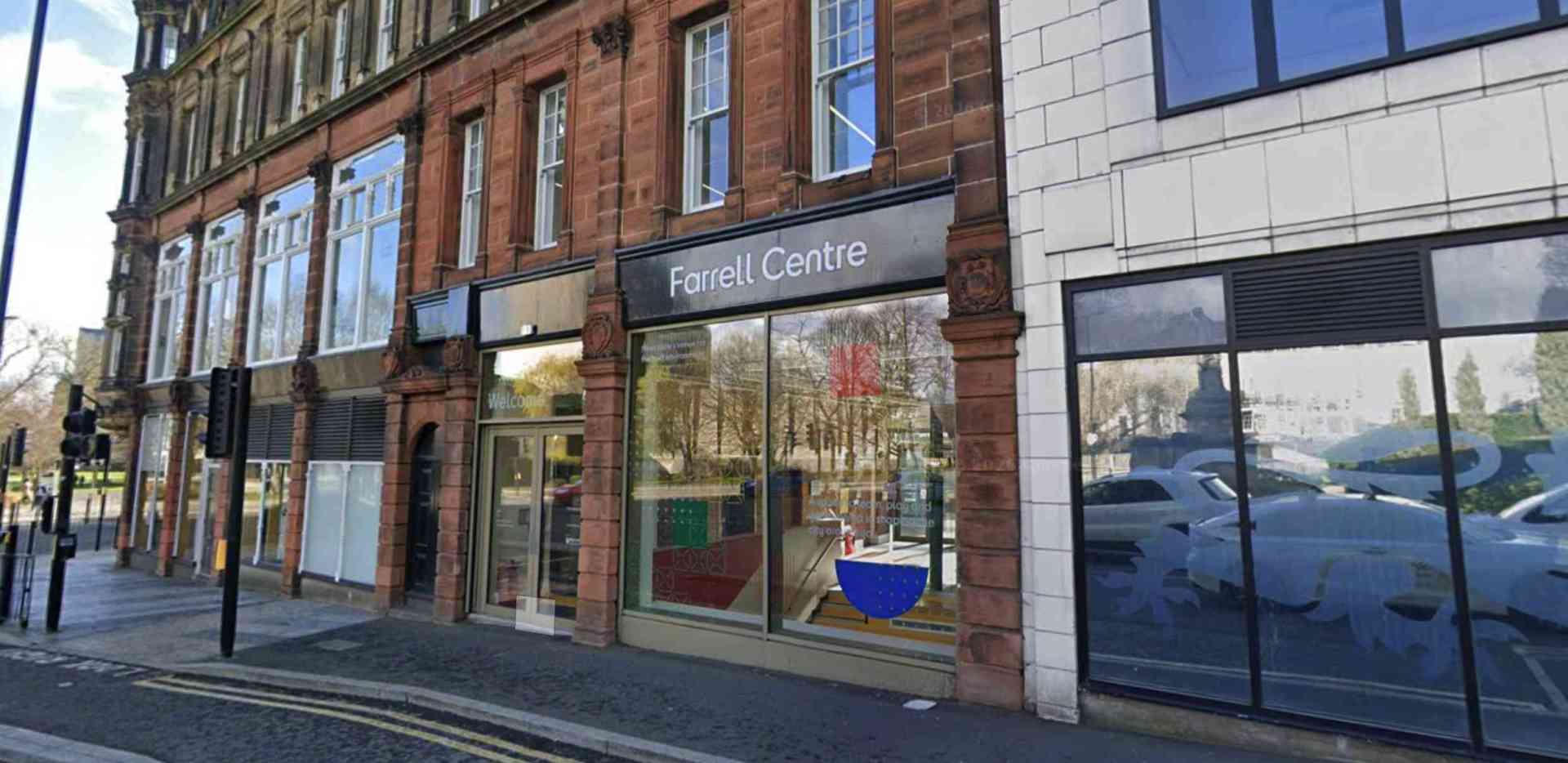 The Farrell Centre (Opened 2023): A Civic Thinktank for the City
The Farrell Centre opened in Newcastle in 2023 – on 22 April to be exact, in a refurbished Grade II-listed building on Eldon Place. The £4.6 million project turned the 19th-century Claremont Buildings into a hybrid of gallery, “urban room“, research hub and public forum. And its aim is quite simple: to widen the debate on architecture and planning and get the public more engaged with these issues. The centre is partly funded by Sir Terry Farrell, who donated £1 million towards the project and, in 2018, gifted his entire archive to Newcastle University.
The centre features exhibitions on sustainable building practices, alongside displays on housing, urban futures and the relationship between people and place. They’ve had “SIDE: Planned Space Lived Place” and “Re: New Towns” on show, as well as interactive workshops and activities for all ages – from Lego model-making sessions for the kids to public lectures on climate and infrastructure.
The building’s refurbishment is itself instructive. The restoration balanced the original Victorian fabric with contemporary galleries, a new staircase, lift and accessible public areas – which is an exercise in careful adaptive reuse that echoes the concerns of many architects in Newcastle upon Tyne working on heritage projects. Space Architects and Elliott Architects handled the work for the consultants.
The Farrell centre is both a monument to Farrell’s achievements and a mechanism that creates an institutional framework through which new voices – including young architects in Newcastle upon Tyne – can debate, contest and shape the city’s direction. It won the RIBA North East Award in 2025, a recognition of its design quality and civic purpose.
Starchitects and Civic Identity: Lessons from Farrell
Farrell’s influence can also give us some useful lessons about the role of “starchitects” in civic identity. The term “starchitect” gets used quite a bit in a dismissive way, but it’s actually a real phenomenon – the massive influence that certain high-profile architects can have on a city’s identity. In the UK you’ve got the likes of Norman Foster, Richard Rogers and Zaha Hadid who’ve lent their name and design style to whole districts and skylines.
Farrell fits into this category but also veers off at a tangent. Unlike Foster who’s made all these world-famous iconic buildings (the Gherkin, the Millennium Bridge) that tend to stand on their own, Farrell’s Newcastle projects put the emphasis on street patterns, scenic views and mixing different types of use into one place. He wasn’t as much interested in slapping up a show-stopping skyscraper as he was in making a better quality of space between buildings. And this came from his deep understanding of how cities work, shaped by his background in both urban planning and architecture.
Of course, the whole idea of attaching a city’s image to a handful of big-name designers does carry some risks. During the period roughly 2000–2010, Farrell’s name was a big deal in Newcastle’s regeneration debates. Photos of his work showed up all over council publications and media coverage. This focus got regeneration moving, but it also raises a pretty uncomfortable question: did all the fuss over one person kind of crowd out other design voices in the North East, or did it make it easier for a new generation of younger Newcastle architects to get in on the ground floor and work within the frameworks he helped set up?
The honest answer is probably a bit of both. And it’s this ambiguity that makes the period after Farrell so interesting.
When the Star of the Show Moves On: The Post-Farrell Decade
Over the 2010s, Farrell’s direct involvement in Newcastle projects started to wind down. His practice began to focus more on big projects abroad – in Hong Kong, Shenzhen and all around the world – and he started to take on more of an advisory and legacy role. The contact between him and the city became a bit less frequent and a lot more formal.
So what took his place? The market, basically. From roughly 2010 to 2025, the key developments in central Newcastle were dominated by student housing blocks, build-to-rent towers and commercial developments near transport hubs. Some of them were actually okay, but not many of them stood out as particularly memorable. And the public criticism was that they all looked pretty much the same – just a bunch of standard, brick-clad, mid-rise blocks that didn’t give a thought to how they fitted in with the rest of the neighbourhood.
The numbers tell a pretty sobering story. According to Newcastle City Council’s own assessment, about 64% of the new two, three and four-bedroom homes built between 2010 and 2018 didn’t meet the Nationally Described Space Standards. Which isn’t exactly a badge of honour for the design community.
Design review panels, local architects and community groups, well they stepped up to the plate and started filling in the gaps where Farrell’s masterplanning might have left off. But their contributions were a bit all over the place. Without that single authoritative voice that could command attention and respect, the development market in many cases just lapsed back into that old, short-term thinking, plot by plot, that Farrell had been trying to get away from.
Heritage, Memory and Changing Times along the Tyne
Newcastle’s built heritage is just incredible. John Dobson, this 19th-century architect in Newcastle, teamed up with Richard Grainger to create Grainger Town, the classic commercial heart of the city that Grainger himself reworked in the 1830s. Grey Street, which Gladstone apparently thought was the finest street in England, still sets the bar for us today. And then you’ve got the city’s modern sustainable developments layered on top of all these other centuries of building and rebuilding.
Farrell’s work struck a balance with this heritage that was really thoughtful. The Quayside plan mixed old warehouses with new facades. The Centre for Life used railway land but was sensitive to the historic surroundings. And of course, the Farrell Centre itself is tucked away in a restored Victorian building.
But the tug of war between conservation and new development is still going on. Around Central Station and the Quayside, you can see the various choices that have been made about whether to keep something old, refit it or knock it down. The Grainger Town Project (1997–2003) poured £145 million into restoring buildings, bringing empty upper floors back to life and just generally reviving the atmosphere. And what it showed is that when you treat heritage as a framework for new ideas rather than just a scenic backdrop, you can get some really amazing results.
And that’s where architects who specialise in heritage come in – practices like Howarth Litchfield, who’ve been quietly getting on with it for over forty years, blending conservation expertise with a genuine commitment to sustainability. They’re the kind of practice that doesn’t make a fuss but just delivers – whether it’s a sensitive retrofit of a listed building or a low-carbon new build that actually works. Alongside them, you’ve got Hugh Massey Architects (founded 1993) who bring conservation expertise together with a feel for ecological sensitivity, and MWE Architects, who’ve been around since 1910 and work right across the spectrum from listed buildings to new-build. These guys show us how to get the past working for us, rather than just preserving it for its own sake. And honestly? That’s the kind of thinking we need a lot more of – less museum, more living, breathing building that does its job without costing the planet.
Housing for Everyone? Newcastle’s Emerging Urban Challenges
The Farrell Centre’s 2026 exhibitions on housing and cities are right on the money – they’re all about the pressures Newcastle’s facing, like affordability, studentification and all these new build-to-rent towers that are basically just there to serve the investors rather than the residents. And what the data is telling us isn’t exactly comforting.Farrell’s own projects in Newcastle mostly steered clear of speculative residential projects. His focus lay elsewhere – in culture, science and mixed use quarters. He seemed to be leaving the housing conundrums for the next generation to tackle. Meanwhile in the city centre housing projects are all over the place in terms of quality. Some of them actually have some public realm and are pretty good at offering tenure diversity although others are just costcutting exercises with a fancy new cladding job
The Local Plan in Newcastle has got some clear targets in place: 60% of new build private housing has got to have a minimum of three bedrooms, and there should be a requirement for adaptable and accessible homes. However, its proving to be a bit of a mixed bag. The difference between what we’d like to see happen and the reality of what gets built is a source of concern for both architects and residents.
The question is – are Newcastle architects actually being empowered to push for something genuinely new in terms of housing? Tenure diversity, climate-proofed design and decent space standards – or are they just asked to wrap a standard off-the-shelf developer box in some locally acceptable materials. Every project is different but the trend suggests that the development market will go with the path of least resistance if the political will isn’t there to push for something better.
Planning, Politics and Saying No
Newcastle City Council’s planning department operates within a pretty restrictive framework of national policy, viability rules and the prevailing political winds which have definitely tightened up since the 2010’s. Its worth noting that local architects should know the planning policies of Newcastle City Council, but being able to get good outcomes from that is a different thing entirely.
The planning decisions that have been made in central Newcastle illustrate the dilemma quite well. Some schemes have been refused or been sent back for re-working because of problems with the streetscape or inappropriate scale, but others – often supported by some dodgy viability arguments – have sailed on through despite all the obvious issues. The contrast with Farrel’s era is pretty jarring – where once the quayside and the Centre for Life were carefully thought through as part of a comprehensive masterplan, most recent development has been driven by the availability of the land and the developer’s bottom line.
Urban design frameworks and supplementary planning documents are in place to try and establish some long-term quality standards. Conservation area management plans cover all 12 of the designated conservation areas in the city. But in the end these instruments are only as good as the confidence of the people behind them. If there’s no public figurehead arguing the case for quality in language that can be understood by the general public and by elected members, the system can default to the lowest common denominator.
The ability to say no to something that’s not up to scratch is a good indicator of civic ambition. And – as Farrell seemed to understand – civic ambition is something that needs to be cultivated over time.
Newcastle’s Architectural Community – Beyond the Single Hero
The story of contemporary architects in Newcastle upon Tyne isn’t just a story about a handful of big names. The city actually has a pretty diverse and vibrant architectural community with a number of different practices all doing their own thing.
- Ryder Architecture – a firm that’s been around in Newcastle since 1953 – is now a major player on the international scene while still having strong local roots.
- Howarth Litchfield – one of the few practices in the region with genuine in-house conservation expertise, which puts them in a unique position when it comes to the tricky business of retrofitting listed buildings for the climate crisis.
- FaulknerBrowns Architects – established in 1962 – specialises in civic and cultural projects.
- MawsonKerr – focuses on sustainable architecture and community spaces in Newcastle.
- CEAD Architects – do masterplanning, urban design and sustainability work across the North East.
These firms – alongside a bunch of smaller studios and sole practitioners – actually shape the city a lot more than a few bright shiny signature buildings ever could. Their buildings – on the whole – are the everyday fabric of urban life – schools, health centres, small mixed use developments, community spaces.
Its worth noting that the title “architect” is protected in the UK and you’ve got to be registered with the ARB (Architects Registration Board) to use it legally. RIBA membership is a sign of your commitment to high standards in architecture. These frameworks provide some level of assurance but they don’t guarantee a good result. When you’re choosing an architect you need to have a good chat about the way they work and what they can deliver for you – including things like the percentage of construction cost they might charge, or whether they’ll do a fixed fee. These practical considerations have a big impact on the relationship between client and designer.
The younger generation of architects in Newcastle are really getting involved in all sorts of community projects – climate conscious retrofit and neighbourhood-scale work – and its worth keeping an eye on them to see whether they’re empowered to challenge mediocrity and come up with some genuinely exciting alternatives – without the need for a high-profile figure to lead the way.
The Farrell Centre as Urban Room: Keeping Debate Alive
If you take a closer look at the Farrell centre you’ll see that whilst its great to have a memorial to Farrell’s work – what’s actually more valuable is the everyday activity that goes on there. The weekly Urban Room sessions are really good at getting locals to take a look at plans and designs and to air their views on the future of their city. Workshops with the kids building with lego and models have the kids thinking about the built environment in a way that’s really engaging. And public lectures that cut through the jargon and tell it like it is – on climate, housing and infrastructure – are a breath of fresh air compared to the standard planning consultations.
The concept of the “urban room” is one that the Farrell Review promoted. Its a permanent civic space where people can engage with the city’s past, present and future – and where architecture is just part of the shared civic conversation. The exhibitions – like “Re: New Towns” – get students imagining future towns in the North East – and linking academic speculation to the real policy debates that are going on in the city.Crucially, the Centre at the heart of the city isnt just a sales pitch for developers. Its run by Newcastle University as a bit of an awkward nephew in the family – a space that can host anyone who has a different opinion to the powers that be, even if that opinion is pretty scathing about recent plans. Its also a teaching tool, a place for professionals and ordinary folks to rub shoulders with one another, and a library of information on how Newcastle has changed over the years.
When an architect of the calibre of Sir Terry Farrell disappears from the scene, institutions like this may well become the city’s moral compass – nudging people, sometimes in a pretty uncomfortable way, to see if their decisions are any good or not – whether they’re making the most of the city’s heritage or stuffing it up. The Farrell Centre is no substitute for the architect himself, but it can at least keep his questions and challenges alive.
Is Newcastle Building a City That’s Truly Worthy of Its Heritage?
Its all coming down to the same question at the end of the day. Sir Terry Farrell left Newcastle a rare gift – a clear idea of who the city was, post-industrial, and how it should respect its heritage, all while making sure the public spaces are pretty great and the buildings actually serve the people who live there. His work on the Quayside, the Centre for Life and the Great North Museum, and all those years of pushing for better planning really changed how people saw the city.
The record since he left though is a bit patchy. We’ve managed to avoid some of the absolute worst of high-rise speculative building that you see elsewhere. Most of our conservation areas are still intact, and the Farrell Centre is a big help in getting people to argue about the right things – something that not many places like ours have. But , there are big parts of the city where it feels like opportunities have been missed – housing that just dont meet the space standards, street-scapes that are a mess, developments that treat the place like its just a blank canvas.
So, without a big name like Sir Terry to define what makes a building a good one and on what grounds, who decides what counts and why? The answer is less about finding another big name to put on the map and more about developing a robust planning system, a group of councillors who are confident in what theyre doing, citizens who are engaged and a bunch of architects and the rest of the community who take their jobs seriously.
Have another look at the Quayside. You cant help but notice Sir Terry’s hand in pretty much every detail – in the way the buildings step up and down the hill, in the views that have been carefully framed, in the sense that this is a place that was designed to be a nice place to be, not just a collection of leftover plots thrown together. But now the next chapter is being written by all sorts of people. And the city has to make a choice, project by project, building by building between just filling gaps and trying to create something genuinely special. Its on us to choose, and to choose well – otherwise itll just fade into the background – a nice memory and a few dusty archive files.
The Farrell Centre is up and running and the debate is still going on. The question is – does Newcastle have the collective guts to answer it properly.