Make demolition illegal. There, I said it. And before anyone rings the planning police, no, I’m not talking about your gran’s garden shed.
I’m talking about the way this country treats perfectly decent buildings as disposable. We demolish them, remove them, and replace them with something new, then congratulate ourselves for installing a heat pump in the new structure. It frustrates me.
Here’s a number to chew on. Making and building with materials is responsible for roughly one tonne in every ten of the UK’s greenhouse gas emissions. That’s around 64 million tonnes of CO₂e a year, according to the UK Green Building Council, which is more than aviation and shipping put together. Think about how much grief we (rightly) give flying. Now consider the last time you heard anyone moan about a wrecking ball.
Exactly.
So I want to make the case. I’ll give the other side a proper hearing too, because some of their points are fair. Then I’ll name and shame ten British buildings that didn’t even make it to 50.
Why the Greenest Building Is the One You’ve Already Got
Bear with me for a minute of carbon accounting. I promise it’s less dull than it sounds.
Every building runs up two carbon bills. There’s the one everyone talks about, operational carbon, which is basically the energy to heat it, light it, and keep the lifts going. We’ve spent twenty-odd years chipping away at that one with insulation, better glazing, heat pumps, and a cleaner grid. Good.
Then there’s the one hardly anyone outside the industry has heard of. Embodied carbon is everything emitted from quarrying, making, lorrying in, and putting together the materials, plus every refit along the way and, at the end, the demolition. The bulk of it is spent before the first tenant gets their keys. Paid upfront. No refunds.
As the running bill gets smaller (and it is getting smaller), that upfront bill turns into the main event. The UKGBC expects embodied carbon to be more than half of all built environment emissions by 2035. More than half!
So what actually happens when we flatten a building that was fine and put up a shiny “net zero” one in its place? The new one starts life in carbon debt. Sometimes it takes decades to claw that back, and plenty of buildings get knocked down before they ever do.
The building that’s already standing has paid. It’s done. Keeping it is just about the cheapest carbon win going, and I genuinely can’t understand why that isn’t the first thing anyone says.
The Bit Nobody Likes to Talk About
Roughly 50,000 buildings come down in the UK every year. That’s the figure the Architects’ Journal has been banging the drum about through its RetroFirst campaign. It’s an estimate, but I’ve never heard anyone seriously argue it down.
Where does it all go? Construction, demolition, and excavation made up something like 62% of all UK waste in 2018 (Defra). Most of the rubble gets crushed and reused as aggregate, which people love to point out. Fine. But crushing a building into hardcore isn’t really recycling it, is it? All the energy that went into making it is gone.
What properly annoys me, though, is this. Embodied carbon in Britain is completely unregulated. Building regs care a great deal about how much energy your building uses once it’s up and running. The carbon it took to build it? The carbon chucked away, knocking down whatever stood there before? Not a word.
France regulates it. So do the Netherlands, Denmark, Norway, Sweden, Finland and Switzerland. The EU is making whole-life carbon assessments mandatory for bigger buildings from 2028 and for everything new by 2030 (UKGBC).
The maddening part is that we don’t even need to invent anything. The industry has already done the homework. Part Z is a ready-to-go amendment to the Building Regulations with more than 200 organizations behind it. Measure whole-life carbon on big projects, then cap the upfront stuff. Simple. MPs debated it in July 2026 and the government said, more or less, that it agreed this was important and Part Z was one option. No timetable. Nothing. You can probably picture my face.
Oh, and tax. This one’s genuinely bonkers. Build a new home, crazy,”nd it’s generally zero-rated for VAT. Repair or refurbish an old one and you’ll usually pay the full 20%. When he was running Historic England, Duncan Wilson called that gap “somewhat crazy”, which if anything is putting it politely. On a big job, 20% can be the whole difference between saving a building and knocking it flat.
Exhibit A: That M&S on Oxford Street
If you want one story that sums up how daft the system is, it’s the Marks & Spencer at Marble Arch.
The building’s called Orchard House. Art Deco, stone-faced, rather lovely, built around 1929–30 and an M&S pretty much ever since. In 2021 Westminster Council said M&S could knock it down (plus two buildings next door) and replace the lot with a ten-story block.
You might remember what happened next, because it ran and ran. Quick version:
-
2021: Westminster says yes.
-
July 2023: Michael Gove, Housing Secretary at the time, calls it in and says no, citing heritage harm and the carbon cost of demolition.
-
2024: M&S takes him to court, and the High Court rules his refusal unlawful.
-
December 2024: Angela Rayner, his replacement, says yes.
M&S’s line was that it had looked at 16 ways of refurbishing the place, and none of them stacked up. The Twentieth Century Society said demolition simply didn’t square with net zero. Kevin McCloud, George Clarke, Bill Bryson, and Griff Rhys Jones all piled in against it.
What hardly anyone mentioned? According to Building Design, the new building nearly doubles the floor space, but the shop space more than halves. It’s mostly offices. So a much-loved department store gets knocked down to build… offices.
Look, you can think M&S made a sensible business decision and still see what’s wrong here. The most argued-over building in Britain couldn’t be saved, because the carbon lost in demolition is just one more thing to “weigh up.” It isn’t a red line. I think it should be.
OK, let’s hear the other side.
I’d be a bit of a hypocrite banging on about this without letting anyone argue back. And to be fair, some of the counter-arguments are decent.
First, some buildings really are rubbish. I’m not daft enough to say everything should be saved. The post-war boom gave us system-built blocks that leaked and cracked within a generation, and the 2023 RAAC scare (crumbling lightweight concrete shutting school classrooms) was a pretty brutal reminder that some things just weren’t built to last.
Second, the demolition trade has a cracking comeback. There’s a piece by Demolition Insider called Don’t Blame the Undertaker, and honestly it’s got a point. Contractors don’t design buildings that only last 30 years. They don’t specify materials that can’t be reused, and they aren’t the ones who let buildings rot. They get called in at the end. The piece also reckons up to 98% of demolition material is recovered and reused.
Third, housing. We need a lot more homes. Swapping a tired low-rise estate for something denser, warmer and safer can house more families on the same land, with lower energy bills too. Hard to argue with that.
And fourth, sometimes refurbishment just doesn’t work. Ceilings too low, columns in the wrong place, fire safety, step-free access… any one of those can kill a conversion. Even the inspector on the M&S case reckoned a meaningful refurb was unlikely.
So yes, all fair. But notice something? None of those points actually defends the system we’ve got now, where knocking down is the easy, cheaper, tax-friendly default and nobody even has to count the carbon. They’re all arguments for exceptions. And I’m fine with exceptions.
So What Would “Illegal” Actually Look Like?
Not handcuffs, before anyone asks. What I want is for the default to flip. You keep the building unless you can show a good reason not to.
In practice I reckon that boils down to five things.
Make demolition prove itself. Want to flatten a substantial building? Fine, show your working. Prove with real numbers that retrofit won’t do the job. A parliamentary heritage group has already called for this and for a VAT cut on retrofit while it was at it.
Count the carbon. Bring in Part Z. Whole-life carbon assessments on big schemes, then legal limits on upfront carbon. The industry asked for reporting by 2026 and limits by 2028. Well, here we are in 2026 with neither.
Sort the VAT out. RetroFirst wants VAT on refurbishment cut from 20% to 5%. While repair gets taxed and new build doesn’t, every spreadsheet in the land will keep pointing at the bulldozer.
Get the public sector to go first. Government is one of the biggest building clients in the country. If it favored reuse on its own projects, everyone else would follow soon enough.
And if you do build new, build it properly. A hundred years, minimum. Structures that can change use. Materials you can take apart and use again.
Is any of that radical? Not really. France, Denmark, and the Netherlands already have embodied carbon limits in law. We wouldn’t be leading anyone. We’d just be catching up.
Britain’s 10 Most Wasteful Buildings: Bulldozed Before Their 50th Birthday
Right. Evidence time.
A half-decent Victorian terrace will happily stand for well over a century. None of these made it to 50. A few were badly built, a few were neglected, some just went out of fashion, and one (honestly, the one that annoys me most) was a modern office block. I’ve ranked them from the longest-lived down to the shortest.
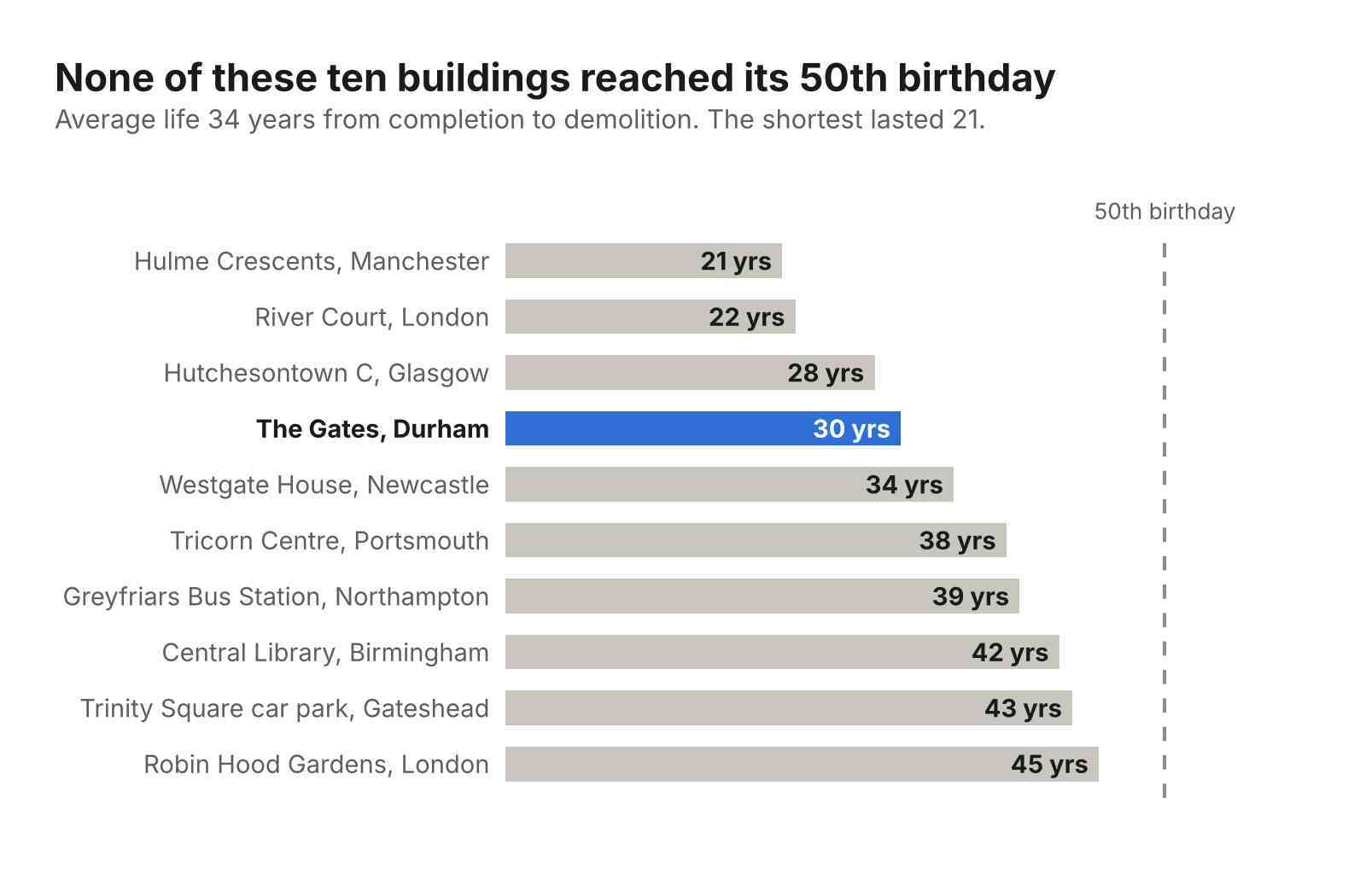
10. Robin Hood Gardens, London (1972; demolition began 2017): 45 years The Smithsons’ famous “streets in the sky” estate in Poplar. Hundreds of architects, Zaha Hadid and Richard Rogers included, fought to get it listed. Didn’t work. A section of it ended up in the V&A, which tells you something. Good enough for a museum, apparently, but not good enough to keep.
9. Trinity Square car park, Gateshead (1967–2010): 43 years The Get Carter car park! If you grew up anywhere near Tyneside, you’ll know it. Michael Caine made it famous, and there was even a rooftop space meant for a restaurant that never opened. It came down in 2010 for a supermarket-led redevelopment. Ugly? Maybe. Iconic? Definitely.
8. Birmingham Central Library (1974–2016): 42 years of John Madin’s upside-down ziggurat, once the biggest non-national library in Europe. Birmingham spent forty years arguing about whether it loved or hated the thing. In the end the new Library of Birmingham opened in 2013, and the old one was gone three years later.
7. Greyfriars Bus Station, Northampton (1976–2015): 39 years It was known as “the mouth of hell,” and Channel 4 viewers voted it Britain’s third most hated building in 2005. Fair enough, it wasn’t pretty. But Arup’s post-tensioned concrete frame was genuinely clever stuff, and they blew it up anyway.
6. Tricorn Centre, Portsmouth (1966–2004): 38 years. Won a Civic Trust award a year after opening. Then became one of the most hated buildings in the country. In its defense, it was in the wrong place and never properly linked to the main shopping street, which isn’t really the building’s fault. The Twentieth Century Society tried to get it listed. No luck.
5. Westgate House, Newcastle (1972–2006/07): about 34 years Twelve storeys of concrete straddling Westgate Road, right opposite Central Station. Channel 4 viewers voted for it to go, and apparently the council didn’t get a single objection. I’ll be honest, I might not have objected either. But unloved and unusable aren’t the same thing, are they?
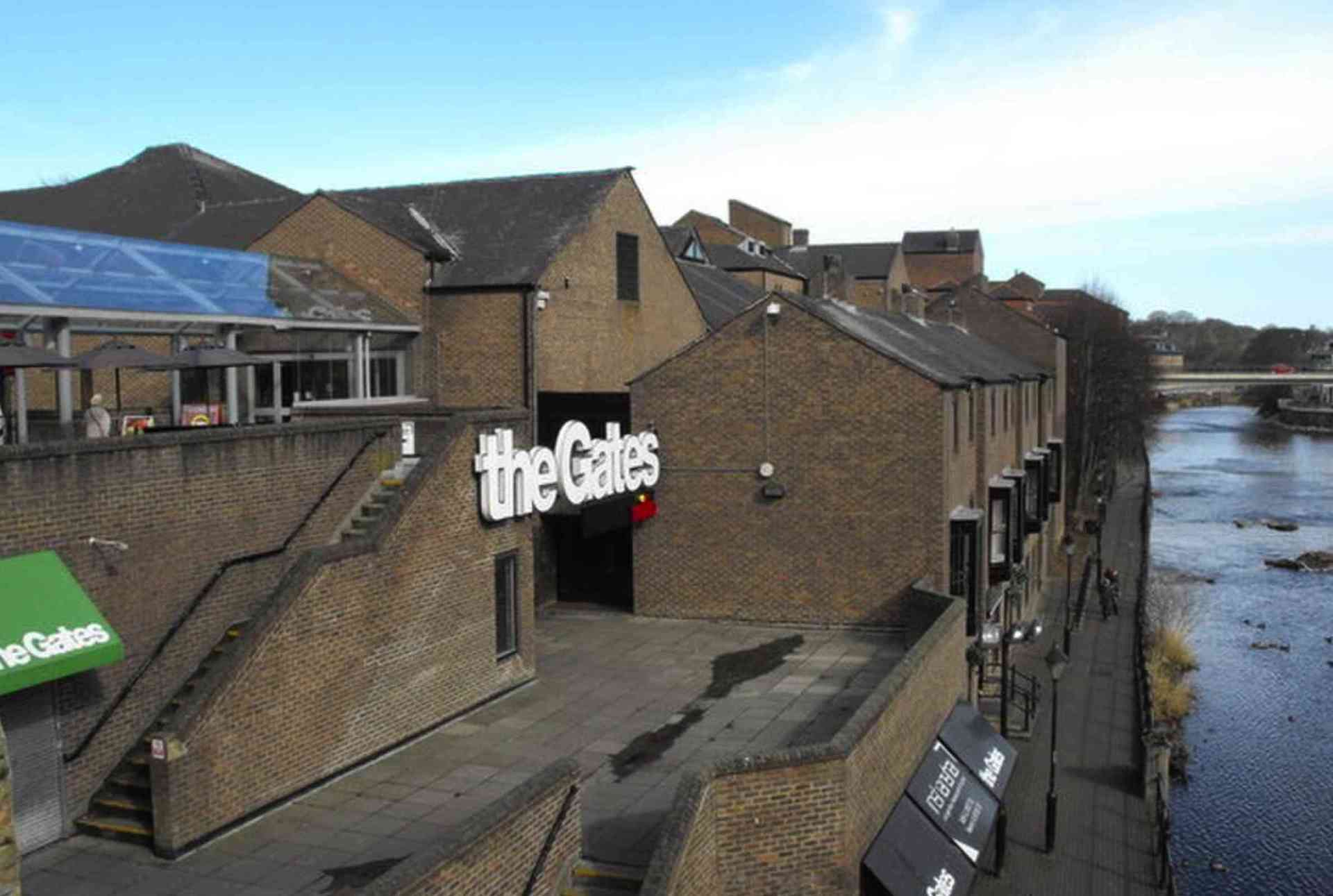
4. The Gates, Durham (1986–2016): 30 years If you know Durham, you’ll know this one. Millburngate’s second phase was finished in October 1986 and opened by Princess Alexandra. It was on a postage stamp, for goodness’ sake, part of a 1984 set celebrating urban renewal. Thirty years later it closed and was demolished for the new Milburngate scheme, and its 1960s neighbor, Milburngate House, went too. Thirty years! Remember that number.
3. Hutchesontown C, Glasgow (1965–1993): 28 years of Basil Spence’s huge slabs in the Gorbals, which were supposed to look like ships in full sail once the washing was out on the balconies. The Queen unveiled the foundation plaque. Then the damp set in, the structural problems piled up, management fell apart, and in 1993 they were blown up.
2. River Court, Fleet Street, London (late 1990s–2022): around 22 years This is the one that really gets my goat. Not a failed estate. Not a grotty car park. It was the modern European HQ of Goldman Sachs. The bank moved round the corner, and the building was demolished for a taller office tower. They kept the two basement levels. That’s it.
1. Hulme Crescents, Manchester (1972–1993): 21 years Four crescents named after Adam, Nash, Barry, and Kent, meant to echo the grand terraces of Bath and London. They leaked. Within two years they’d been judged unsuitable for families. Barely two decades after they went up, they were coming down.
What do you notice?
I see two quite different problems in that list. Some of these were never built to last, and the fix for that is building better in the first place, not demolishing more. Others (Robin Hood Gardens, River Court) went because something newer and bigger made more money. It’s that second habit I want gone.
Thirty Years vs Nine Hundred
Told you I’d come back to Durham.
If you’ve ever stood on Framwellgate Bridge, you’ve seen this whole argument in one view without realizing it. On one side was The Gates. Opened 1986, gone 30 years later. Over the Wear there’s the cathedral, started in 1093 and still doing exactly what it was built for more than 900 years on. And here’s a lovely bit of timing: the cathedral and castle became a UNESCO World Heritage Site in 1986. Same year The Gates was finished.
The people who built that cathedral didn’t have carbon budgets. They didn’t have Part Z. They just built things to last and assumed the next lot would look after them.
We know so much more than they did, and we’ve got a climate crisis they couldn’t have dreamt of. So is it really too much to ask that we stop knocking down buildings with decades of life left in them?
I don’t think so.
Make demolition illegal. Then make every exception earn it.